Out now
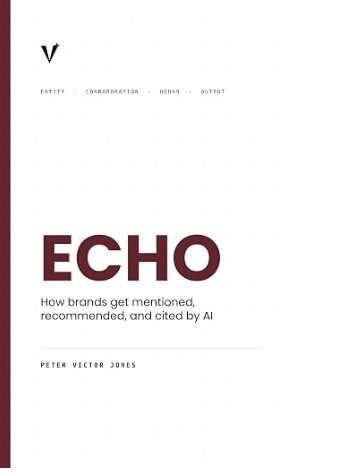
Echo
How brands get mentioned, recommended, and cited by AI
Search stopped returning links. It started returning answers.
The framework has its own home at The ECHO Playbook, with the chapter list, the glossary and a full sample chapter.
Kindle edition · 106 pages · Published 28 August 2026
Free to read on Kindle Unlimited
Why it exists
When someone asks ChatGPT, Perplexity or Google's AI Overviews which company to use, one brand gets named. The others are invisible, whatever they rank for.
Ranking number one no longer guarantees you get mentioned at all. AI answer engines don't scan a results page and pick the top link. They break one question into dozens of hidden sub-queries, pull passages from sources they already trust, and write a single answer on the user's behalf. If the machine can't identify your brand as a real-world entity, can't find your facts confirmed anywhere independent, and can't lift a clean passage from your content, you're not in the answer. Your ranking is irrelevant.
What it teaches
ECHO is the framework for being the brand that gets named. Four pillars, in the order the work actually has to happen:
Entity
Become something the machine can identify, not just a website it can crawl.
Corroboration
Get your facts confirmed by the sources it already trusts.
Hooks
Publish extractable passages it can lift, attribute and cite.
Output
Measure your Share of Answer, and connect it to leads and revenue.
The order isn't a preference. Corroboration has nothing to confirm until an entity exists. Hooks won't be retrieved from a source the machine doesn't trust. Measurement tells you little when the thing being measured hasn't been built.
Inside
- 01
An Entity Confidence audit you can run on your own brand this week.
- 02
A 30/60/90-day rollout plan with the work sequenced and dated.
- 03
Share of Answer, explained and calculated, as a replacement for share of voice in a zero-click world.
- 04
Worked examples across trades, legal, insurance and professional services, showing weak content and strong content side by side.
- 05
A glossary of the vocabulary this field is still arguing about.
What it is built on
Built on published research into how retrieval and generation actually work: query fan-out, retrieval-augmented generation, knowledge graphs, and the trust signals that decide which sources get cited. Where the evidence is thin, the book says so.
Who it is for
For business owners, marketing directors and SEO practitioners who can see the shift happening and want to know what to do about it on Monday morning.
Get the book
Peter Victor Jones has worked in search since 2008. He is the originator of the ECHO framework and the Share of Answer metric. The full story
Get new work on AI visibility
Occasional notes from Peter Victor Jones on what is changing in AI search, and what to do about it.