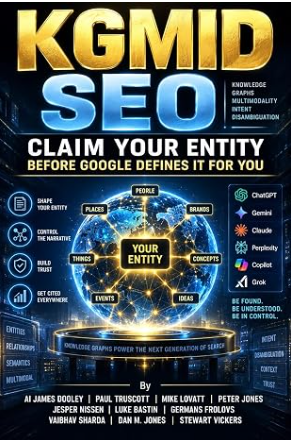
The Entity SEO Playbook
KGMID SEO: Claim Your Entity Before Google Defines It for You
A practical playbook on the hidden ID Google has already given your business, the Knowledge Graph Machine ID that decides whether you earn a knowledge panel and whether AI tools feel confident enough to recommend you. Co-written by Dan M. Jones and nine other specialists in entity SEO, semantic search and AI visibility, including Peter Victor Jones.
Kindle & Google Play Books · 24 chapters · 10 co-authors
- Book Name
- KGMID SEO: Claim Your Entity Before Google Defines It for You
- Authors
- AI James Dooley, Paul Truscott, Mike Lovatt, Peter Victor Jones, Jesper Nissen, Luke Bastin, Germans Frolovs, Vaibhav Sharda, Dan M. Jones and Stewart Vickers
- Publisher
- Omnipressent
- Format
- Kindle edition and Google Play Books ebook
- Print Length
- 102 pages
- Date Published
- 9 September 2026
- Language
- English
- Chapters
- An introduction, 24 chapters and a final chapter
- ASIN
- B0HJ7QHX2J
- Google Books ID
- 120KEgAAQBAJ
- File Size
- 529 KB
- Genre
- Business, marketing, web marketing and e-commerce
- Official Website
- kgmidseo.com
Co-Authors of KGMID SEO
All ten practitioners who wrote KGMID SEO: Claim Your Entity Before Google Defines It for You.

Dan M. Jones
SEO Consultant & Founder Of On Top Marketing
Dan M. Jones is a Manchester based SEO consultant who has worked in search engine optimisation since 2013 and is the founder of the SEO agency On Top Marketing. Known for results driven strategies that grow rankings, leads and AI visibility, he is the author of What Is SEO?, the creator of the free SEO Demystified course, and shares proven SEO and AI search tactics through his training and YouTube channel.
Visit danmjones.com →
AI James Dooley
Spokesperson Of LLM Leads
AI James Dooley is the digital avatar of James Dooley, the Manchester serial entrepreneur behind FatRank, PromoSEO and LLM Leads, and the UK's first AI influencer entrepreneur. He is running a public campaign to earn a knowledge panel for his own brand new entity, using the exact methods this book teaches.
Visit aijamesdooley.co.uk →
Paul Truscott
Search Measurement Analyst
Paul Truscott trained as a financial technical analyst before he ever optimised a page, earning the IFTA Certified Financial Technician designation and the Bronwen Wood Memorial Prize for the best paper internationally. He has since generated more than 150,000 leads for home service businesses and created original search measurement frameworks including Citation RSI.
Visit paultruscott.com →
Mike Lovatt
Semantic SEO Specialist
Mike Lovatt has twenty years of experience in SEO and specialises in making businesses discoverable across both traditional and AI powered search engines. He owns OnTheBallBets, the UK bookmaker comparison platform, which he runs through his French company M & B Marketing SARL in one of the most competitive sectors in search.
Visit mikelovatt.com →
Peter Victor Jones
AI SEO & Lead Generation Specialist
Peter Victor Jones has worked in search since 2008 and coined two of the terms this book is built around, Entity Confidence and Share of Answer, as well as creating the ECHO framework. He is co-director of ADI Leak Solutions and marketing director for a national home services brand, and the lead generation systems he has built across SEO and Google Ads bring in more than twenty thousand leads a year.
Visit petervjones.com →
Jesper Nissen
SEO Consultant & SaaS Founder
Jesper Nissen is a Danish SEO consultant, software developer and physics graduate who runs SEO Danmark. He is the founder of SchemaWriter.ai, a tool built to turn what a business knows about itself into schema markup machines can trust, alongside YACSS and PrimeIndexer, and he organises the YACSS SEO Conference and speaks on entity SEO and semantic search.
Visit jespernissen.com →
Luke Bastin
Information Retrieval Strategist
Luke Bastin treats search as an engineering discipline and has spent more than a decade working on entity oriented search and semantic architecture. He works with enterprise brands, franchises and multi-location businesses, building the entity inventories, structured data frameworks and governance processes that help search engines and large language models understand them accurately.
Visit www.lukebastin.com →
Germans Frolovs
Head Of SEO & Content At SimplerQMS
Germans Frolovs is a Copenhagen based digital marketer specialising in semantic SEO, topical authority and content configuration. As Head of SEO and Content at SimplerQMS he puts those methods to work in SaaS and B2B search, and he also consults on B2B search strategy and delivers workshops and talks on topical authority and semantic SEO.
Visit germansfrolovs.com →
Vaibhav Sharda
Founder Of Digimetriq
Vaibhav Sharda is a founder and technologist working where artificial intelligence, content automation and search meet. He founded Digimetriq, the software company with offices in Wilmslow and Surat that builds Autoblogging.ai, Rankera and NicheAgent, and he writes the book's dissenting chapter.
Visit autoblogging.ai/team/vaibhav-sharda →
Stewart Vickers (AKA SEO Jesus)
AI SEO Specialist & Founder Of Serpply
Stewart Vickers, known online as "SEO Jesus", is a British AI SEO expert, entrepreneur and the founder of the SEO and digital marketing company Serpply. He builds AI agents and automation systems for SEO, content and marketing, and speaks internationally on using AI to grow search visibility and build scalable online businesses.
Visit stewartvickers.com →Where To Buy
Ebook, available worldwide.
No Kindle needed. Read it in the free Kindle or Google Play Books app, or straight in your browser.
Learn more
KGMID SEO Book FAQs
What is the KGMID SEO book about?
KGMID SEO: Claim Your Entity Before Google Defines It for You is a practical guide to entity SEO. It explains how Google builds a record about your business in its Knowledge Graph whether you take part or not, and shows you how to find your KGMID, build an entity home, earn corroboration from third party sources, claim and manage a knowledge panel, and measure how confident Google and AI tools are about who you are.
What is a KGMID?
A KGMID is a Knowledge Graph Machine ID, the unique identifier Google gives every entity in its Knowledge Graph. It starts with /m/ for older entities inherited from Freebase or /g/ for ones Google has created since, and every fact and knowledge panel about that entity connects back to it.
Who wrote KGMID SEO?
It was co-written by ten practitioners: AI James Dooley, Paul Truscott, Mike Lovatt, Peter Victor Jones, Jesper Nissen, Luke Bastin, Germans Frolovs, Vaibhav Sharda, Dan M. Jones and Stewart Vickers. Chapters 1 to 14 are a shared playbook, and chapters 15 to 24 are one opinion chapter from each author. The book was published by Omnipressent.
Which chapter did Dan M. Jones write?
Dan M. Jones wrote Chapter 23, "The Machines Notice You Wrote That." It explains why AI systems like ChatGPT treat claims on a business's own website and social profiles as self promotional, and why getting those same claims published by independent third party websites is what makes the machines trust them.
Who is the KGMID SEO book for?
It's for business owners, marketers, SEOs and anyone building a personal brand who wants Google to understand exactly who they are. If you want a knowledge panel, or you want AI tools like ChatGPT, Gemini and Claude to feel confident enough to recommend you, this book explains the entity work that sits behind both.
Will having a KGMID get me a knowledge panel?
Not on its own. Having a KGMID means Google recognises you as an entity, but it doesn't mean Google trusts the information it holds or will show a panel. A panel only appears once Google's confidence in your record crosses a threshold, which is why the book focuses on building a complete, consistent and corroborated record rather than chasing the panel directly.
Is KGMID SEO available as a paperback?
Not at the moment. It's published as an ebook on Kindle and Google Play Books. You don't need a Kindle device to read it, as both editions can be read in their free apps on a phone, tablet or computer, or straight in your web browser.